 繁體中文
繁體中文  简体中文
简体中文  한국어
한국어  Français

How to cut cheese
France produces over 300 types of cheese. Round, square, heart-shaped, pyramid-shaped, etc. From the rind to the core, the taste of a cheese is never the same. Depending on whether it is square or round, it is matured in a different way. It is generally stronger near the rind, while the texture is creamier, and at times even chalky, while the sides are more flavourful. In the light of this wide variety of shapes and textures, cutting rules have been defined in order to reap the full potential of the taste of the cheese.

© CNIEL
Adjusting the cutting method depending on the shape and type of cheese
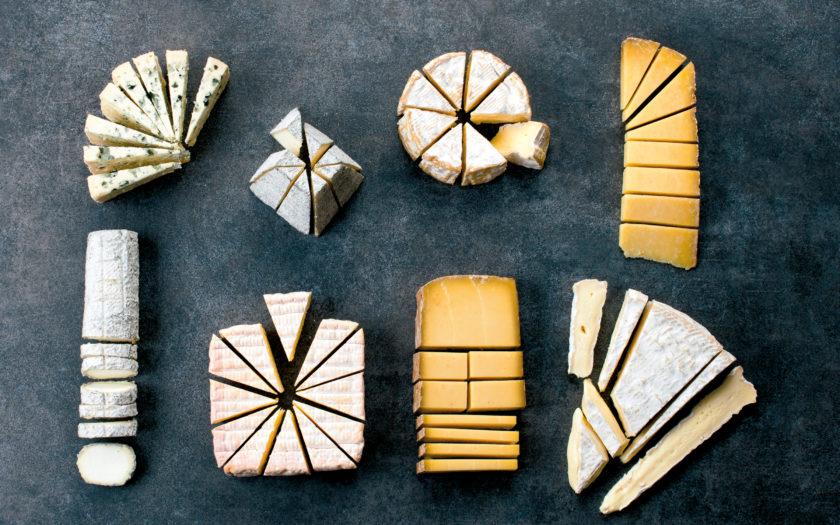
Flat, round cheeses (such as Camembert, Coulommiers and Reblochon)

You treat the cheese like a cake by starting to cut it from the centre and dragging the knife towards the outside.
Large round cheeses (such as Brie de Meaux, Brie de Melun and Coulommiers)

Since it is not desirable to leave all the rind until the end, you do not cut the nose of the cheese. There are two solutions:
- firstly, cut the point: just a few portions wide. Then, along the length, cut portions perpendicular to the heel.
- Cut into long slices, as you would do with a Camembert, then cut these slices in two once more.
Small round cheeses (such as Pélardon, Crottin de Chavignol and Picodon)

Small round cheeses can be cut in two or four.
Square or heart-shaped cheeses (such as Valençay, Charollais, Maroilles, Pavé d’Auge, Pont l’Évêque, Carré de l’Est and Neufchâtel)

You handle these like you would round cheeses like Camembert.
Cheeses in the shape of a pyramid or cylinder

You cut these like round or square cheeses, into thin, long portions going from the very top of the cheese right to the bottom. You should be able to cut it into at least 8 portions.
Large slices of cheese wheels (such as Comté, Salers and Morbier)

You should have part of the centre and part of the rind on your plate. To do this, you start by cutting slices from the centre parallel to the rind, then, once you’ve cut half of the portion, cut the heel in the other direction, or into a fan shape.
Cheeses served with a spoon (Mont d’Or, Vacherin)

Given their runny consistency, some cheeses must be served with a spoon. A special technique is required to serve Mont d’Or which consists in cutting 90% of the way through the upper rind of the cheese and then lifting it, like you would the lid of a tin can.
Logs of cheese (such as Sainte-Maure de Touraine)

Cut into slices, having first removed the container. If the log has a straw through its centre, it’s better to remove the straw to make sure your slices do not break.
Blue cheeses in a cylindrical shape (such as Fourme d’Ambert)

Blue cheeses in a cylindrical shape must be first sliced, and then cut like a Camembert.
Wedges of cheese (such as Roquefort)

Blue cheeses cut into wedges must be placed flat and cut into a fan shape from the centre of the thin part.
Very hard cheese (such as Mimolette extra aged)

It can be simply broken up or cut into shavings. As for Tête de Moine, it is shaved into the shape of a rosette using a special cheese cutter.
The right tools
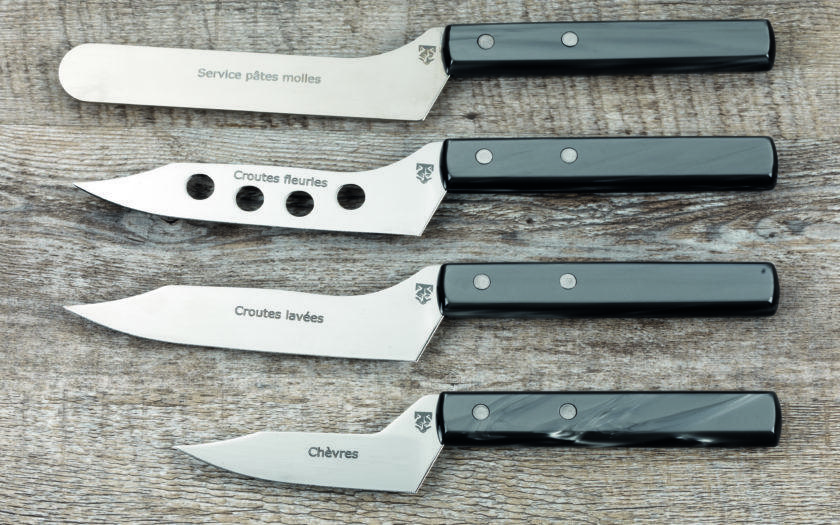
It is important to use knives that are suited to each cheese so that the different aromas do not mix. Each knife is assessed to cut cleanly depending on the texture of the centre and shape of the cheese.
Flat knife for serving soft cheeses

This tool is used to form a tongs with another knife in order to delicately lift a portion of soft or goat’s cheese and place it on a plate without breaking it.
Knife for soft cheeses with bloomy rinds

The aim is to cut cheeses with a creamy, sticky texture without the cheese sticking to the long, hollow ground blade.
Examples: Coulommiers, Chaource
Knife for soft cheeses with a washed rind

It is used to cut cheeses with a supple, soft and perhaps runny texture.
Examples: Maroilles, Livarot, Langres
Goat’s cheese knife

It is used to cut flaky cheeses such as goat’s cheeses. It has a small blade that is suitable for cutting cheeses the size of goat’s cheeses.
Examples: Sainte-Maure de Touraine, Rocamadour, Pélardon
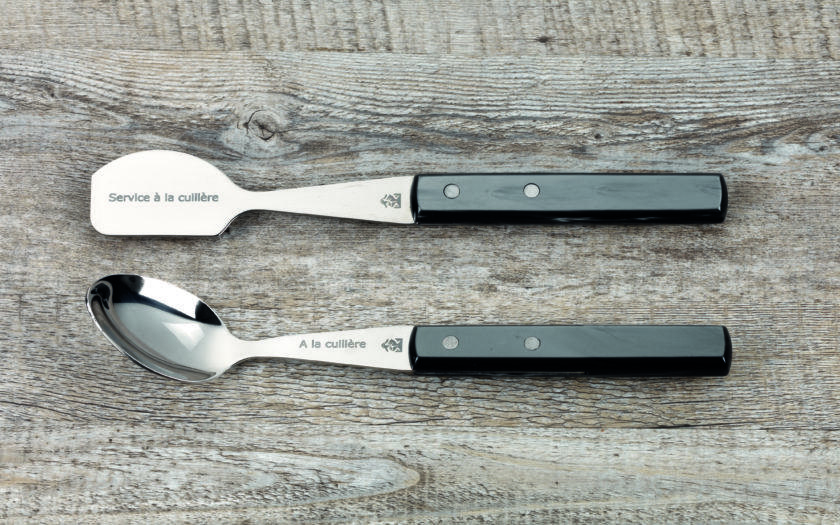
Spoon

It is used to serve very creamy or runny cheeses such as Epoisses and Mont-d’Or Service with a spoon.
Service with a spoon

It is used to remove creamy cheese from the spoon and place the cheese on the plate cleanly.
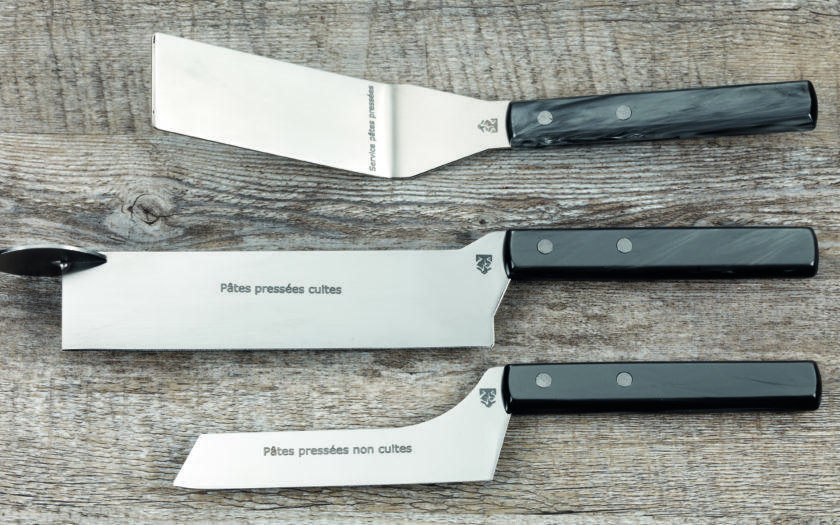
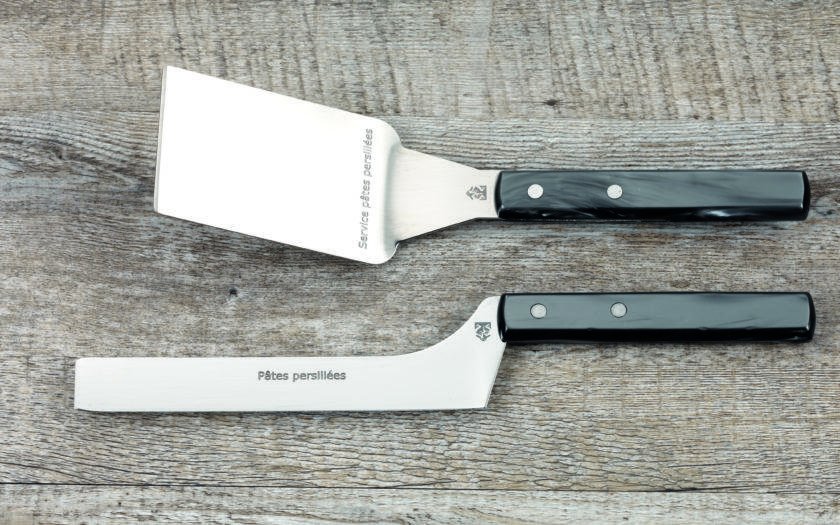
Flat knife for serving pressed cheeses

This tool is used to make a tongs with another knife in order to delicately lift a portion of cooked or uncooked pressed cheese and place it on a plate without breaking it.
Knife for cooked pressed cheese

It is suitable for cutting hard cheeses. By placing your thumb against the part located at the end of the blade and pressing against it while you cut, it makes it easy to cut very hard cheeses such as Mimolette extra aged, Parmesan, Beaufort and Comté
Knife for uncooked pressed cheeses

This is a knife with a long blade that is used to slice large cheeses with a relatively hard centre.
Examples: Reblochon, Saint-Nectaire, Morbier
Knife for serving blue-veined cheese

This tool is used to remove the portion of blue-veined cheeses from the knife in order to place it on the plate without breaking it.
Knife for blue-veined cheeses

This knife with its wide blade is used to slice fragile blue-veined cheeses to ensure they do not crumble.
Examples: Roquefort, Bleu des Causses, Fourme de Montbrison.
Lyre

This is mainly used to slice goat’s cheese or other soft, fragile cheeses that come in small sizes. The lyre’s wire is used to slice crumbly, moist cheeses cleanly and without breaking them.
What does “trimming a cheese” mean?
It means gently cutting off the end pieces of the cheese to make it look freshly sliced.